Introduction
A stand mixer is a relatively simple machine from the outside, but several mechanical components work together inside the housing to transfer power from the motor to the mixing attachment. When one of those components becomes worn or damaged, the mixer may begin making unusual noises, struggle under load, or stop transferring power correctly to the attachment hub.
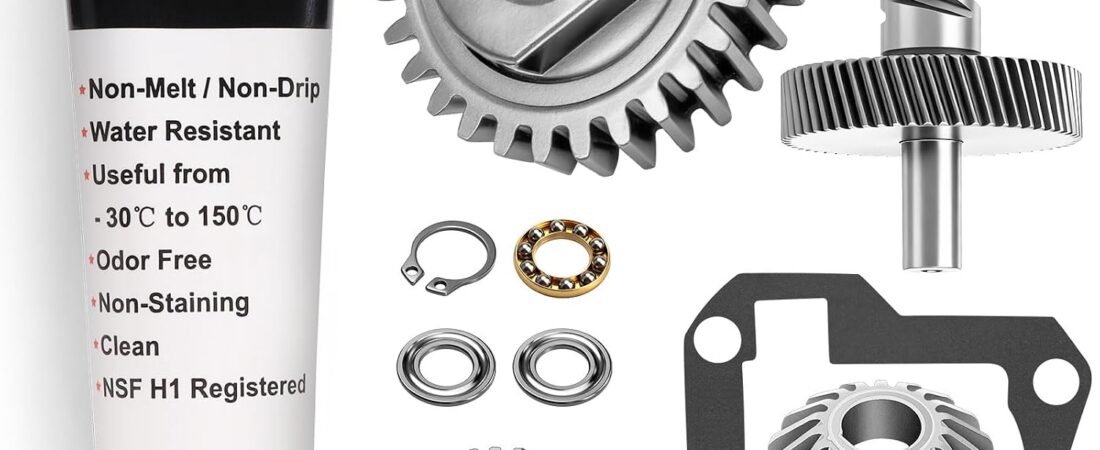
The 9706529 Worm Gear Kit for Whirlpool/KitchenAid 5QT & 6QT Stand Mixer is a replacement-part type designed for certain Whirlpool and KitchenAid stand mixer models. The supplied Amazon listing identifies the product as an Ohoho replacement part and references several related part numbers, including 9706529, WP9709231, and W11086780.
A worm gear is an important component within the transmission system of many stand mixers. Its job is not simply to spin an attachment directly. Instead, it participates in a gear arrangement that transfers and reduces rotational speed while providing the torque needed for mixing tasks.
Understanding the purpose of this part is useful before attempting a repair. A replacement worm gear should not automatically be considered the solution to every stand mixer problem. Symptoms such as unusual grinding, slipping, failure to turn, or excessive noise can originate from different mechanical or electrical components.
For that reason, identifying the correct mixer model and diagnosing the underlying problem are important steps before purchasing or installing a replacement gear.
This guide explains what the 9706529 worm gear kit is intended to do, how worm gears function in stand mixers, what situations may indicate a gear-related problem, considerations when selecting a replacement, and how this type of repair part compares with other approaches to stand mixer maintenance.
Key Features
Replacement worm gear configuration
The main component of this kit is a worm gear used in the transmission of compatible stand mixers.
In a typical stand mixer transmission, the motor produces rotational movement at a speed that is not directly suitable for the mixing attachment. Gears transform that movement into a slower rotational speed with greater usable torque.
The worm gear is part of that mechanical relationship.
When the gear becomes damaged or excessively worn, the transmission may no longer operate smoothly. Depending on the particular failure, the mixer may produce unusual mechanical sounds, operate intermittently, or fail to drive the attachment correctly.
The replacement part is therefore intended for repair rather than general modification.
Referenced part numbers
One of the most important features of replacement appliance parts is the collection of identifying numbers associated with the component.
The Amazon listing references 9706529, along with related numbers including WP9709231 and W11086780.
Part numbers are generally more useful for compatibility checking than relying only on descriptions such as “5-quart mixer” or “6-quart mixer.”
Two mixers can have similar capacities and external designs while using different internal components.
For that reason, users should compare the exact part number and mixer model information before ordering.
Compatibility with selected Whirlpool and KitchenAid mixers
The listing identifies compatibility with certain Whirlpool and KitchenAid stand mixers in the 5-quart and 6-quart range.
However, capacity alone should not be treated as sufficient proof of compatibility.
A 5-quart mixer can exist in multiple model families, and internal transmission designs can vary between generations.
The safest approach is to locate the complete model number from the mixer itself, consult the appliance’s parts documentation, and compare the required replacement part number.
Mechanical power transmission
The worm gear participates in the mechanical transmission between the motor and mixing system.
Its purpose is connected to two important requirements of a stand mixer:
- Controlling rotational speed
- Transferring usable torque
A stand mixer needs relatively high torque for demanding mixing tasks. Thick dough, heavy mixtures, and extended operation can place significant mechanical load on the transmission.
The gear system allows the motor’s rotation to be transformed into an output speed appropriate for mixing.
Replacement-oriented design
A worm gear kit is generally intended for repairing an existing mixer rather than replacing the appliance itself.
This can be useful when the mixer remains mechanically and electrically sound but has developed a problem localized to its transmission.
Repairing a single mechanical component can also be relevant when the rest of the appliance remains suitable for continued use.
However, the economic and practical value of a repair depends on the condition of the entire mixer.
Small mechanical component with a large role
The worm gear is physically much smaller than the stand mixer housing, bowl, or motor assembly, but its position within the transmission makes it important.
A damaged gear can prevent the motor’s rotational energy from being transferred effectively.
This illustrates why a mixer can sometimes appear to have a functioning motor while the attachment itself does not operate correctly.
The motor may still make noise and rotate internally while the transmission is unable to deliver motion to the output shaft.
Understanding How a Stand Mixer Worm Gear Works
The basic transmission concept
A stand mixer needs different rotational characteristics from those produced directly by an electric motor.
Electric motors can rotate rapidly, while mixing attachments generally operate at much lower speeds.
A gear system bridges this difference.
The transmission reduces speed while increasing usable torque at the output. Different gears work together to accomplish this conversion.
The worm gear forms part of this arrangement.
Why speed reduction matters
Imagine connecting a mixing attachment directly to a high-speed motor.
The resulting rotational speed would be inappropriate for normal mixing and could create serious mechanical and safety problems.
A gear train allows the machine to operate at controlled speeds.
The user can then select different mixer settings while the internal transmission converts the motor’s rotation into an appropriate output speed.
Why torque matters
Speed is only one part of the equation.
Mixing bread dough or other dense ingredients requires substantial torque at the attachment.
Torque describes rotational force. The transmission allows the motor to deliver useful rotational force at a much lower output speed.
This is why a gear component can become stressed when a mixer repeatedly handles heavy mixtures.
Gear wear and mechanical stress
Gears are subjected to repeated mechanical contact.
Over time, the teeth can wear, become damaged, or develop other defects. Lubrication condition, loading, operating habits, manufacturing tolerances, and the condition of other transmission components can influence how the gear behaves.
A worm gear that has been damaged may not maintain proper contact with its mating gear.
That can result in noise, vibration, slipping, or failure to transmit power.
How It Can Be Used
Replacing a damaged transmission component
The most direct use of a 9706529 worm gear kit is to replace a worn or damaged worm gear in a compatible stand mixer.
This is a mechanical repair and typically involves opening the mixer housing and accessing the transmission.
Because the transmission contains multiple moving components and lubricant, replacement is more involved than simply exchanging an external accessory.
The repair should be approached systematically.
Restoring attachment movement
If the motor operates but the mixing attachment does not turn properly, the transmission is one area worth investigating.
A damaged worm gear can be one possible cause.
However, several other components can produce similar symptoms, including shafts, other gears, bearings, couplings, or mechanical obstructions.
Diagnosis should therefore come before replacement.
Repairing unusual transmission noise
Grinding, clicking, or other unusual mechanical sounds can indicate a transmission problem.
A damaged gear can create abnormal contact between gear teeth.
However, noise can also come from other sources.
A bearing, loose component, insufficient lubrication, or another damaged gear may produce a similar sound.
Replacing the worm gear without identifying the source can therefore result in an incomplete repair.
Supporting preventative inspection
Even when the worm gear is not obviously broken, opening a transmission during a repair can provide an opportunity to inspect other components.
An experienced repairer can examine the mating gear, shafts, bearings, housing, and lubrication condition.
This can help identify whether the worm gear failed independently or whether another underlying issue contributed to its wear.
Who It May Be Suitable For
DIY appliance repairers
People who are comfortable disassembling small appliances may find a replacement worm gear relevant when repairing a compatible stand mixer.
Mechanical aptitude is important because the repair involves internal components rather than an external accessory.
Appliance technicians
Professional or experienced appliance repair technicians may use replacement transmission components when servicing compatible mixers.
For technicians, exact part-number identification is particularly important because a workshop may handle multiple mixer generations.
Owners of otherwise functional mixers
A replacement part may be worth considering when the mixer has a localized mechanical problem but the motor, controls, housing, bowl, and attachments remain in reasonable condition.
Repairing a single component can sometimes extend the useful service life of an appliance.
Users maintaining older equipment
Stand mixers can remain useful for many years.
When an older appliance develops a mechanical problem, replacement parts can provide an alternative to immediately replacing the entire machine.
The availability of compatible parts can be particularly valuable for owners who already have accessories and attachments that fit their existing mixer.
People with mechanical repair experience
Because accessing the worm gear generally requires disassembly, this type of replacement is more appropriate for someone who understands mechanical assemblies or is prepared to follow a reliable service procedure carefully.
A person unfamiliar with appliance repair may prefer professional assistance.
Important Things to Consider
Confirm the complete model number
The single most important step is confirming compatibility.
Do not rely only on the fact that the mixer has a 5-quart or 6-quart bowl.
Locate the complete model number on the appliance and compare it with the replacement-part information.
The Amazon listing provides compatibility information, but appliance model variations can exist even within the same capacity category.
Match the part number
Part numbers provide another layer of verification.
The supplied listing references 9706529 and related numbers such as WP9709231 and W11086780.
When several numbers are associated with a replacement part, it can be useful to check the appliance’s original parts diagram or service documentation to determine which number applies to the specific mixer.
Diagnose before replacing
A worm gear should not be replaced simply because a mixer is making noise.
A mixer can experience problems from many different sources.
For example:
- Worn bearings
- Damaged mating gears
- Loose shafts
- Coupling problems
- Insufficient or degraded lubrication
- Electrical motor problems
- Mechanical obstructions
- Incorrect assembly
The symptom may point toward the transmission, but it does not automatically identify one particular component.
Unplug the appliance before servicing
Any repair involving internal access to an electrical appliance should begin with the appliance disconnected from its power source.
Do not rely on the control switch being turned off.
Disconnecting the power reduces the risk of accidental motor operation while the housing is open.
Understand the complexity of disassembly
A stand mixer transmission contains multiple components that must return to their correct positions.
Depending on the model, disassembly can involve screws, housing sections, shafts, gears, bearings, retaining components, and internal lubrication.
Taking photographs during disassembly can help document the original arrangement.
Organizing screws and small parts by location can also reduce the chance of incorrect reassembly.
Pay attention to lubrication
Gear transmissions generally depend on appropriate lubrication.
When a transmission is opened, the condition and amount of lubricant can become relevant.
Using an inappropriate lubricant can affect gear operation, seals, materials, or food-appliance safety considerations.
The correct lubricant and quantity should come from the appropriate service documentation for the mixer rather than being guessed.
Inspect the mating components
Replacing one damaged gear does not necessarily solve the underlying problem.
The worm gear interacts with other transmission components.
If the mating gear is also worn or damaged, installing a new worm gear against a defective component may result in continued noise or premature wear.
A thorough inspection is therefore important.
Consider the cause of gear failure
Gear damage can sometimes result from excessive mechanical load.
Stand mixers are designed for particular operating conditions, and heavy dough can put significant stress on the transmission.
Repeated operation under excessive load can contribute to mechanical wear.
Following the manufacturer’s operating recommendations for the particular mixer is therefore important.
Check the package contents
The supplied Amazon listing should be consulted for the exact package contents and current specifications.
Replacement-part listings can be updated, and different versions of a product may exist.
If a repair requires additional components, such as seals, lubricant, bearings, or other gears, those parts may need to be sourced separately.
Food-appliance considerations
Although the worm gear is an internal mechanical component, the appliance is ultimately used to prepare food.
Any repair should therefore be completed carefully.
Internal lubricants should not be allowed to contaminate food-contact areas.
After reassembly, the mixer should be inspected for leaks, abnormal sounds, loose components, and proper attachment operation before returning it to normal food preparation.
Signs That a Mixer May Have a Gear-Related Problem
The motor runs but the attachment does not turn
This can indicate a transmission problem, although it can also result from other mechanical failures.
If the motor sounds normal while the attachment remains stationary, the power-transfer path deserves inspection.
Grinding or clicking noises
Unusual mechanical sounds can be associated with damaged gear teeth.
The exact sound can vary depending on which component is affected.
A grinding noise should not automatically be attributed to the worm gear without inspection.
Intermittent movement
If the attachment turns sometimes and slips at other times, a mechanical transmission problem may be present.
Loose components, damaged gears, or shaft problems can all contribute to intermittent operation.
Increasing noise under load
A transmission that sounds acceptable when running empty but becomes unusually noisy while mixing may be experiencing load-related mechanical stress.
This can be a useful diagnostic clue, although it does not identify the exact failed part by itself.
Visible gear damage
If the transmission has been opened for inspection, damaged teeth, unusual wear patterns, cracks, or deformation can provide stronger evidence of a gear problem.
Photographing the damaged component before removal can also help when comparing it with the replacement part.
Comparison of General Replacement-Part Categories
Worm gear replacement
A worm gear replacement focuses on one component of the transmission.
This can make sense when the damaged part has been positively identified and the remaining transmission components are in suitable condition.
The repair requires mechanical disassembly but can avoid replacing an otherwise functional mixer.
Complete gear assemblies
Some repairs may call for a larger transmission assembly rather than an individual gear.
A complete assembly can reduce the need to identify every internal component, but it may involve a more substantial replacement and different costs.
Whether this approach is appropriate depends on the mixer model and the nature of the failure.
Original manufacturer parts
Original manufacturer parts are designed around the specifications of the corresponding appliance.
They can provide a straightforward compatibility path when the correct part number is available.
The main consideration is identifying the exact component required for the particular mixer.
Aftermarket replacement parts
Aftermarket components can provide additional repair options for older appliances.
However, compatibility, dimensions, materials, tolerances, and included components can vary between suppliers.
A part should therefore be evaluated based on exact compatibility information rather than appearance alone.
Professional repair
Professional repair eliminates much of the uncertainty associated with disassembly.
A technician can diagnose the failure, inspect the transmission, replace the appropriate component, and verify operation.
The trade-off is that the service cost can be higher than performing a repair independently.
Replacing the entire mixer
A complete appliance replacement is another option when a mixer has multiple significant problems.
If the motor, control system, transmission, housing, and accessories all show substantial wear, replacing one gear may not be the most practical long-term approach.
On the other hand, a mixer with one localized mechanical failure may still have considerable useful life remaining.
A Practical Repair Workflow
Step 1: Identify the mixer
Locate the model number and record it.
Do not rely solely on the bowl size or external appearance.
Step 2: Identify the suspected failure
Document the symptoms.
Does the mixer:
- Make grinding noises?
- Fail to turn the attachment?
- Slip under load?
- Produce unusual vibration?
- Stop intermittently?
A clear description can help distinguish between mechanical and electrical possibilities.
Step 3: Verify the replacement part
Compare the mixer model and existing component number against the replacement listing.
For the supplied product, the referenced numbers include 9706529, WP9709231, and W11086780.
Step 4: Disconnect power
Unplug the mixer before opening the housing.
Step 5: Document disassembly
Take photographs and keep components organized.
This is particularly helpful when several gears or washers look similar.
Step 6: Inspect the complete transmission
Do not immediately remove the worm gear.
Inspect surrounding components for damage, wear, contamination, and abnormal lubrication.
Step 7: Replace the damaged component
Install the replacement according to the applicable service instructions.
Avoid forcing components into place.
Step 8: Reassemble carefully
Verify that gears, shafts, retaining components, and housing sections are correctly positioned.
Step 9: Test without food
After reassembly, operate the mixer according to an appropriate safe testing procedure.
Listen for abnormal noises and observe whether the attachment moves correctly.
Step 10: Recheck after initial operation
If unusual noise, slipping, heat, or other abnormal behavior appears, stop operation and investigate rather than continuing to use the mixer.
Frequently Asked Questions
What is a 9706529 worm gear?
The 9706529 worm gear is a mechanical transmission component associated with certain Whirlpool and KitchenAid stand mixers. The supplied Amazon listing identifies 9706529 as a relevant part number and also references WP9709231 and W11086780.
What does a worm gear do in a stand mixer?
A worm gear participates in the transmission that transfers motor rotation to the mixing mechanism. The gear system helps reduce rotational speed and provide the torque required for mixing.
Is the 9706529 compatible with all KitchenAid mixers?
No assumption should be made that every KitchenAid mixer uses the same worm gear.
The listing references particular Whirlpool and KitchenAid models and 5-quart and 6-quart applications. Users should verify the exact model number and part number before ordering.
Is bowl capacity enough to determine compatibility?
No. Bowl capacity is useful as a general reference but does not uniquely identify the internal transmission.
The complete mixer model number is a more reliable way to verify compatibility.
What other part numbers are associated with this replacement?
The supplied Amazon listing references 9706529, WP9709231, and W11086780.
The correct number for a specific mixer should still be confirmed against its model and service documentation.
Why would a stand mixer need a worm gear replacement?
A worm gear can wear or become damaged through normal mechanical use, particularly when transmission components are subjected to repeated load.
Symptoms can include abnormal gear noise, slipping, or failure to transfer power to the attachment.
However, those symptoms can also originate from other components.
Can I replace the worm gear myself?
Someone with appropriate mechanical repair experience may be able to replace the component, but the repair requires internal disassembly.
If you are unfamiliar with appliance transmissions or electrical appliance repair, professional service may be more appropriate.
Does replacing the worm gear fix all mixer grinding noises?
No.
Grinding noises can originate from multiple components, including other gears, bearings, shafts, lubrication problems, or loose parts.
A proper diagnosis should identify the source before replacing a specific component.
Does the replacement include the entire transmission?
A worm gear kit should not automatically be interpreted as a complete transmission assembly.
The current Amazon listing should be checked for the exact package contents before ordering.
Why is lubrication important?
Gear teeth and other transmission components depend on appropriate lubrication to reduce friction and wear.
The correct lubricant should be determined from the appropriate service information for the particular mixer.
Can a damaged mating gear cause another worm gear to fail?
Potentially. If the mating gear is damaged or excessively worn, installing a new worm gear without addressing the other component may leave the underlying mechanical problem unresolved.
Should the mixer be tested immediately after installation?
After reassembly, a careful functional test can help confirm whether the transmission is operating normally. The mixer should be disconnected from power during assembly, and any abnormal noise or behavior during testing should be investigated.
Can this type of repair extend the life of an older mixer?
A successful repair can allow an otherwise functional appliance to continue operating. Whether that makes sense depends on the condition of the entire mixer, including the motor, controls, transmission, housing, and other mechanical components.
What should I do if the replacement part does not fit?
Do not force it into place.
Recheck the mixer model, part number, dimensions, and the listing’s compatibility information. A visually similar gear may still have different specifications.
Conclusion
The 9706529 Worm Gear Kit for Whirlpool/KitchenAid 5QT & 6QT Stand Mixer is a replacement transmission component intended for certain compatible stand mixer models. The supplied Amazon listing identifies it with part numbers including 9706529, WP9709231, and W11086780, while describing compatibility with selected Whirlpool and KitchenAid 5-quart and 6-quart mixers.
The worm gear has an important role in the mechanical transmission of a stand mixer. By participating in the gear system that transfers and reduces motor rotation, it helps provide the controlled speed and torque necessary for mixing.
When a mixer develops grinding sounds, slipping, or problems transferring motor power to the attachment, the transmission can be one area worth investigating. A damaged worm gear may be responsible, but similar symptoms can originate from other components. Diagnosis is therefore an essential part of the repair process.
For a compatible mixer that otherwise remains in good condition, replacing an individual transmission component can be an alternative to replacing the entire appliance. At the same time, the repair requires careful disassembly, correct lubrication, appropriate reassembly, and attention to electrical and mechanical safety.
Compatibility should remain the first consideration. Bowl capacity alone is not enough to establish whether a particular gear will fit. The complete mixer model number and relevant part number should be compared with the current replacement-part information before proceeding.
Anyone comfortable with mechanical appliance repair may find this type of replacement project manageable with the correct service documentation and careful preparation. Those without the necessary experience can consider professional appliance repair instead.
A replacement gear is ultimately only one component of a larger transmission system. Inspecting the surrounding gears, shafts, bearings, lubrication, and housing can help ensure that the actual source of the problem is addressed rather than simply replacing one part based on symptoms.